
The results of the energy efficiency work in SBF’s property Safiren 2 are truly impressive. District heating demand is estimated to be reduced by more than 80 per cent, and net zero purchased electricity is likely to be achieved on an annual basis, including tenants’ own use. Behind the success lies a mix of proven measures, smart innovations – and a determined Head of Property Management with a talent for thinking outside the box. This is the story of Sweden’s first microgrid installed in an older residential property.
Combine an ambitious sustainability strategy with a driven and inventive enthusiast who is given the mandate and opportunity to act. When the same enthusiast also hears political statements about Swedish property owners being too slow in transitioning their older residential properties – then things can really get moving.
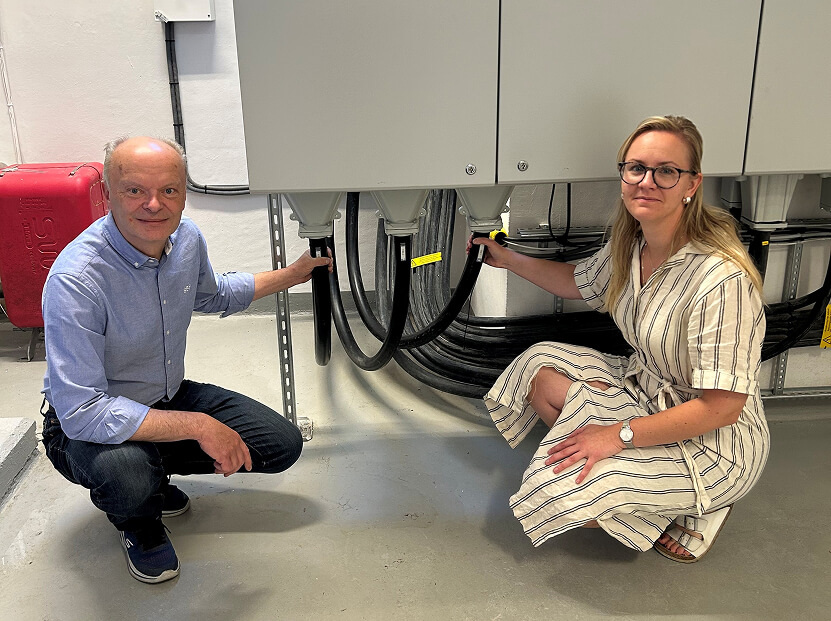
Bo Wernersson and Ida Karlsson at the control room in the Safiren 2 property.
Bo Wernersson is Head of Property Management at SBF Fonder. The large portfolio for which he has the overall responsibility, includes the five residential buildings that make up the Safiren 2 property in Kalmar. After implementing the important but perhaps more expected energy efficiency measures – such as installing new heat pumps and heat exchangers, adding insulation to the attics, changing to new windows and balcony doors, and installing a smarter control system – several major benefits were achieved. A more stable indoor climate, fewer complaints from the tenants, reduced energy consumption and lower operating costs.
Unfair criticism and rigid regulations
The early measures in Safiren 2 were a good start, but Bo and SBF are rarely satisfied with just doing what others do. When Bo also heard that the Swedish Energy Committee thought that Swedish property owners were too slow in transitioning their older apartment buildings, he felt it was time for two things. Firstly, he wanted to highlight how the regulatory framework in place at the time made it difficult to convert older properties effectively. He also wanted to show what could be achieved with the right conditions.
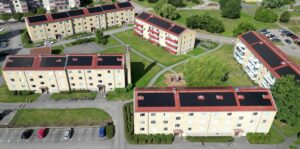
The five residential buildings that make up the Safiren 2 property in Kalmar.
Today, five years later, it is a satisfied and proud Head of Property Management who shows us the buildings on Daléngatan in Kalmar. Here, SBF has created a so-called microgrid, a local energy system that produces and distributes electricity within a limited area. The system can work both together with the regular electricity grid and independently, for example in the event of a power outage.
A lot of attention
Microgrids in newly built houses or facilities is not new. The reason that the Safiren project in Kalmar has attracted so much attention is because it is the first time a microgrid has been created in an existing, older apartment block. In combination with several other innovative measures, the result is an extremely energy-efficient property.
“The interest in our solutions has been big. Swedish Television, Swedish Radio and the business newspaper Dagens Industri have all been here. We have also had many other property owners, authorities and energy companies on site visits. It feels great – both as proof that we have achieved something good, but most of all because there are thousands of other properties that can make similar journeys,” says Bo Wernersson.
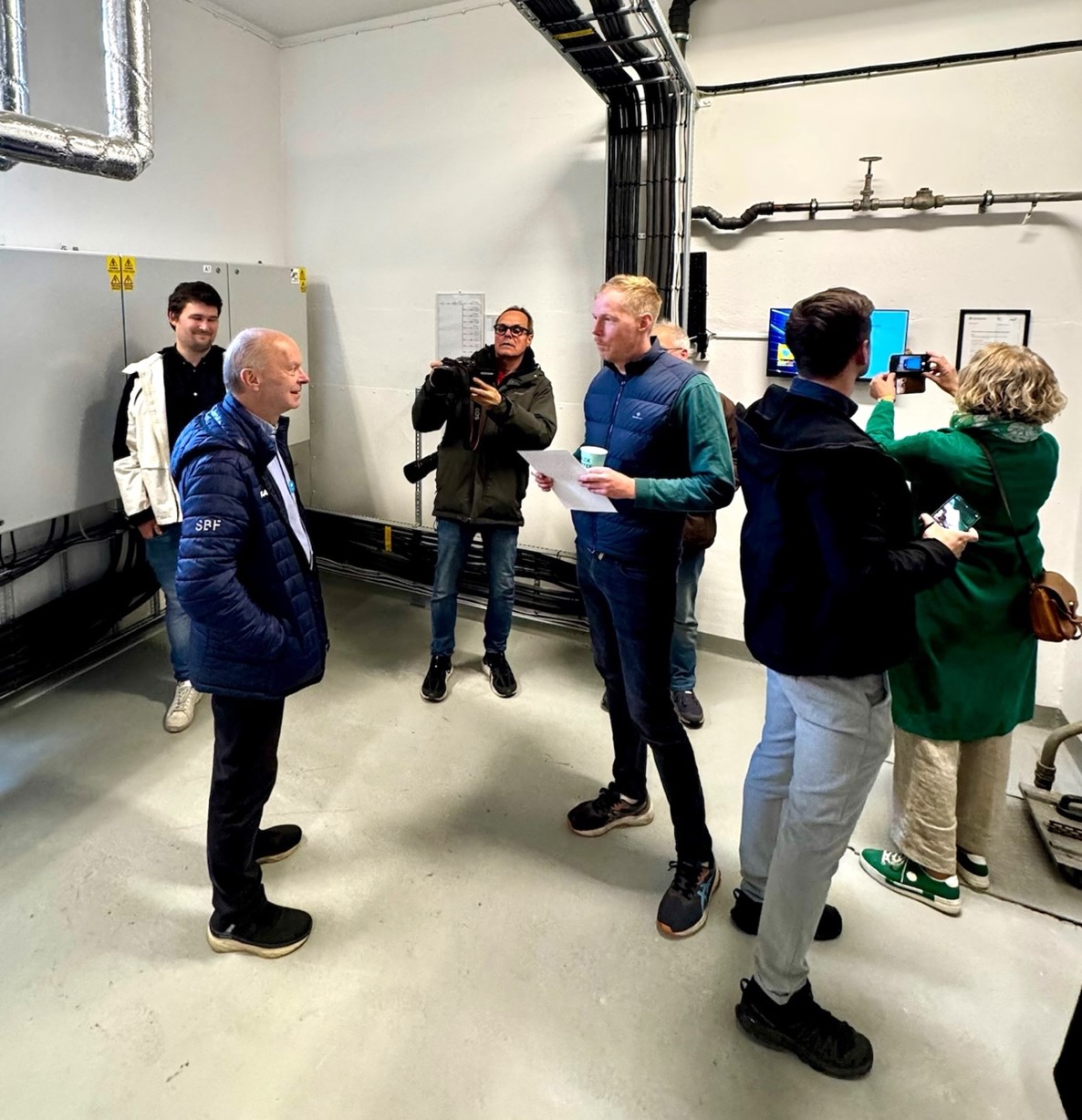
Bo shows the facility at the project’s inauguration in May 2025.
New ways to reduce energy consumption
The roofs of the five residential buildings are fitted with a total of 727 solar panels, whose electricity production can be used in several ways – directly by the tenants or in the operation of the building, stored as thermal energy in the building’s 8 000 litre water tanks, or sold via the electricity grid.
Since the property now has a single main connection to the external electricity grid, with the five buildings interconnected through a microgrid, it is possible to control and optimize solar electricity production and consumption among the buildings, depending on where solar panels are producing the most or where demand is highest. Additionally, the new, more powerful grid connection enables increased solar electricity sales during periods of clear weather and high production.
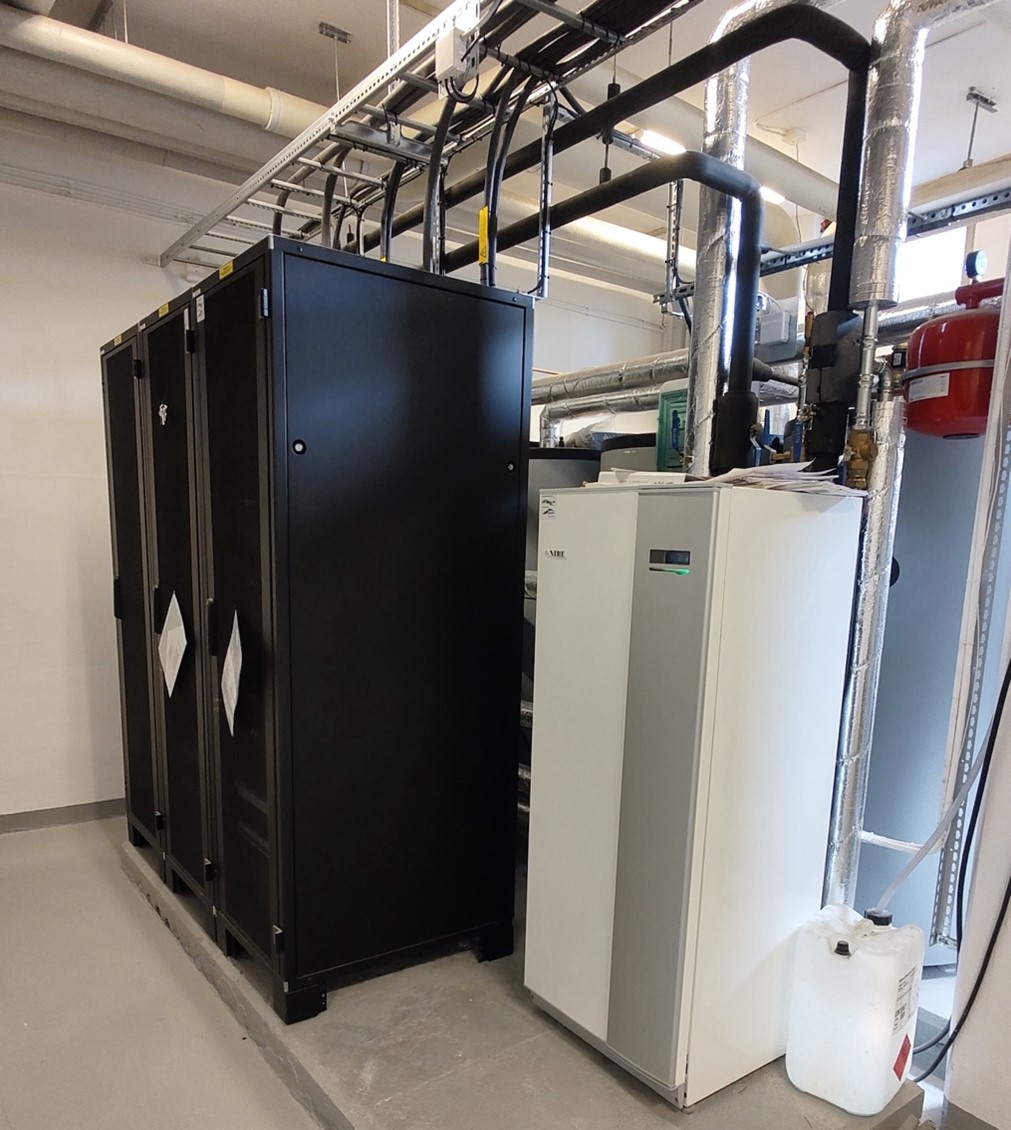
New inverters and the exhaust air heat pump.
According to Bo, the results from the operational data look extremely good so far, and the forecast of future energy use is promising, to say the least:
“We estimate that the district heating consumption in the property will be more than 80 per cent lower than before we started our energy efficiency work. District heating is expensive today, and often has a negative climate impact, so in the future we hope to only use district heating as a supplement when it is very cold outside. We also estimate that the property will achieve net zero on an annual basis for purchased electricity, including the tenants’ own use.”

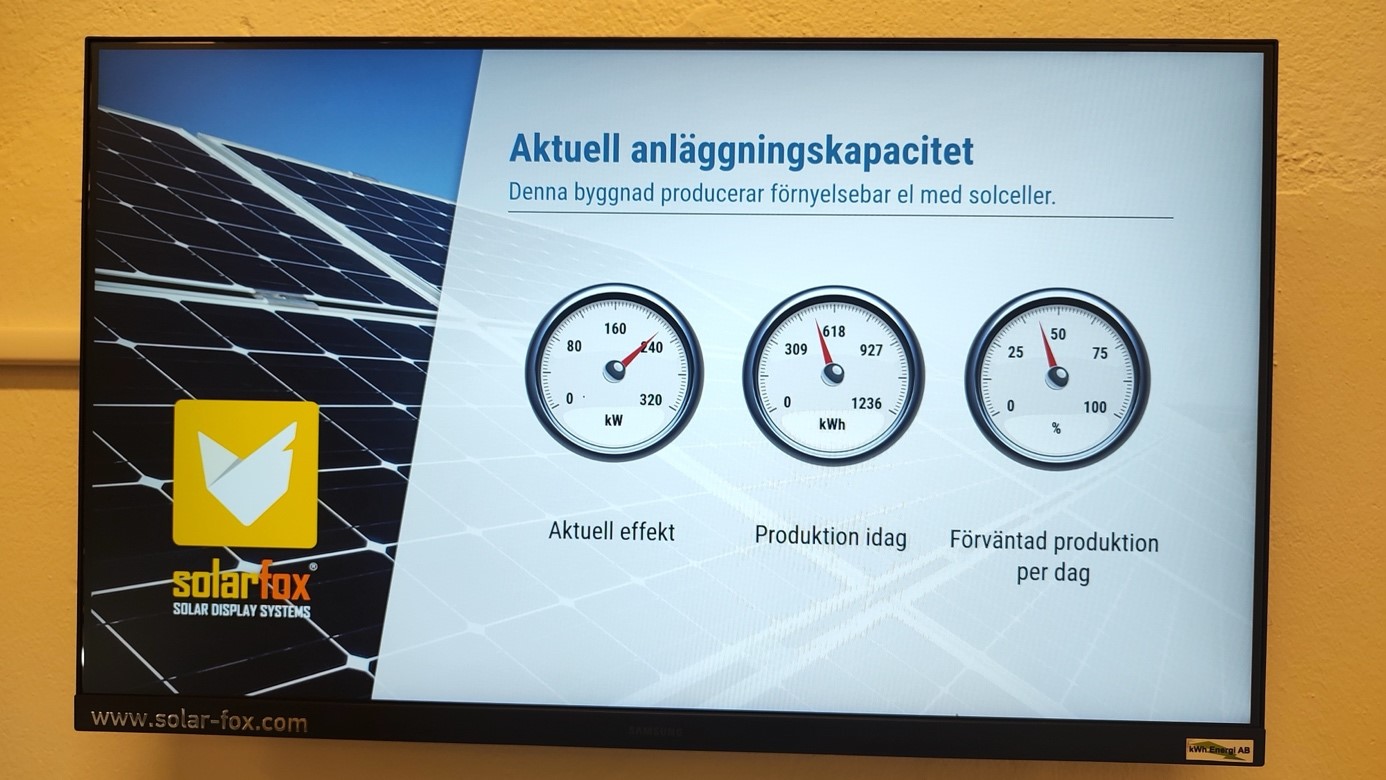
It’s easy to monitor the solar energy production on screens in the building.
Increased safety and cheaper electricity bills
The possibility of so-called ‘island mode’, when the property is disconnected from the external electricity grid and still manages itself, can also be important in the event of a crisis or war. When the sun is not shining, a diesel generator could be used to generate electricity for both the 97 apartments and the property’s three protective shelters. Bo has therefore notified the Swedish Civil Contingencies Agency about the Safiren solution.
Some tenants have commented on the increased safety in energy supply, along with the joy of cheaper electricity bills. Not only does the microgrid reduce SBF’s energy costs, but tenants also save around SEK 2,000 per apartment per year. This is due to reduced connection fees and a framework agreement under which tenants pay SBF’s purchase price for green electricity plus a small supplement charge, regardless of whether the electricity is produced by the property’s solar panels or purchased from the grid.
Lennart Eriksson has lived here for almost ten years and is positive about the microgrid:
– So far, everything has worked well, and it is of course nice to have cheaper electricity bills. Also, considering the state of the world today, it feels good to reduce our dependence on external energy. It will be interesting to see how efficient the heating system is when the cold weather comes. I was a little sceptical at first, but I have followed the project from afar and think it seems to be well thought out and solidly executed.
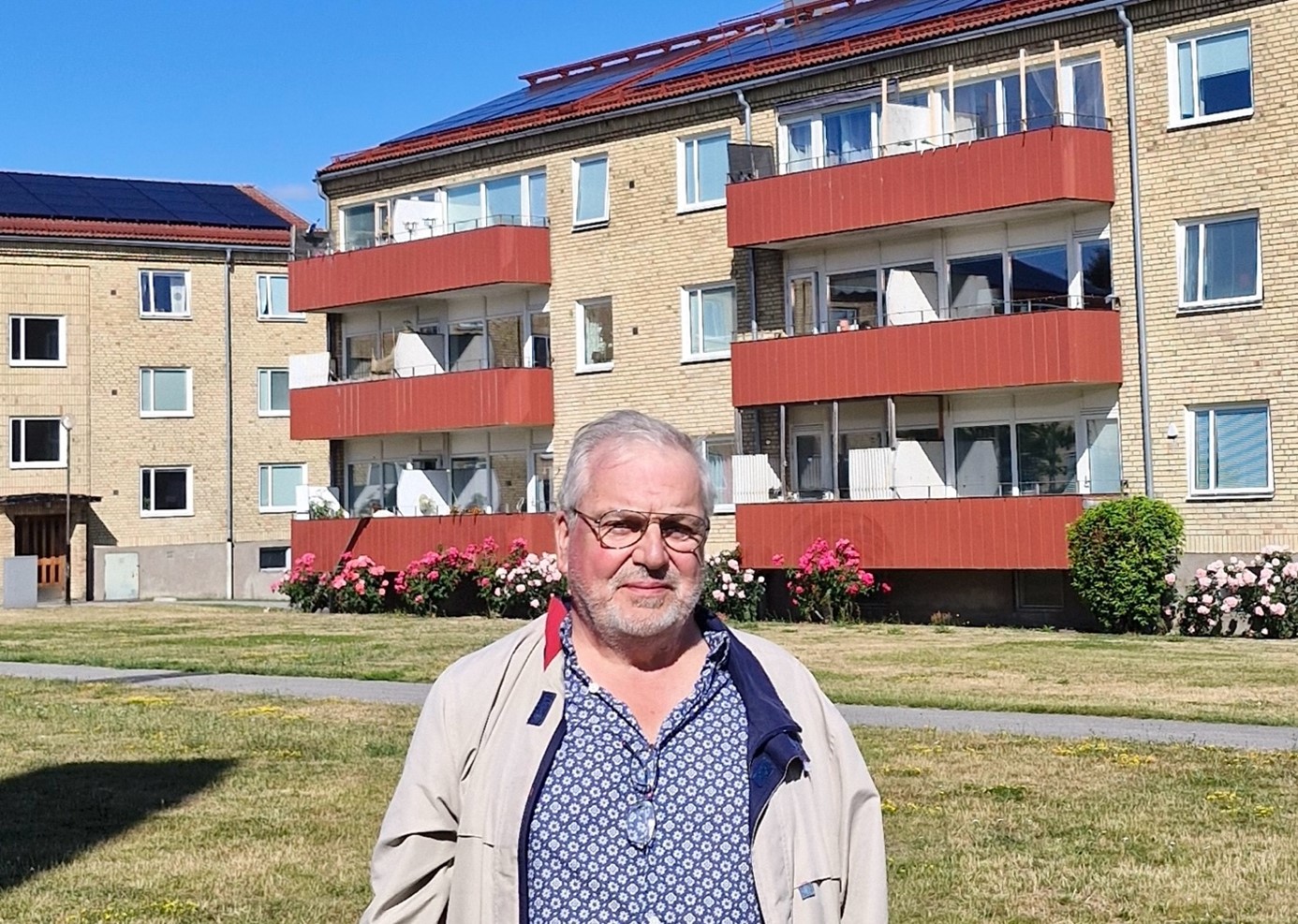
The tenant Lennart Eriksson is pleased with the microgrid and his lower electricity costs.
Tough journey but worth the effort
The Safiren project has been a long and sometimes wearing journey, not least because of opposition and objections from authorities and energy companies. But thanks to Bo Wernersson’s determination and the broad support from the entire SBF-team, the project is a great success.
“I’m stubborn, but this would not have been possible without the support I’ve received. Not only from colleagues, management, the board and some of the tenants, but also from more unexpected quarters. Some of those who were initially very negative have changed their attitude along the way, sometimes even becoming enablers and ambassadors. I have learnt that willpower and persistence are not enough. You must be a bit pedagogical too, so that people understand what you want to achieve, how and why. We can accomplish so much more when we work together”, says Bo.
Cooperation forum at national level
The strong need for a more modern and flexible regulatory framework has also resulted in the cooperation group ‘Green transitioning of older rental properties’, in which several Swedish authorities, organisations and companies participate, together with Bo Wernersson as representative of SBF. The group meets regularly and some of its’ members were present when the microgrid in Safiren 2 was inaugurated in May 2025.
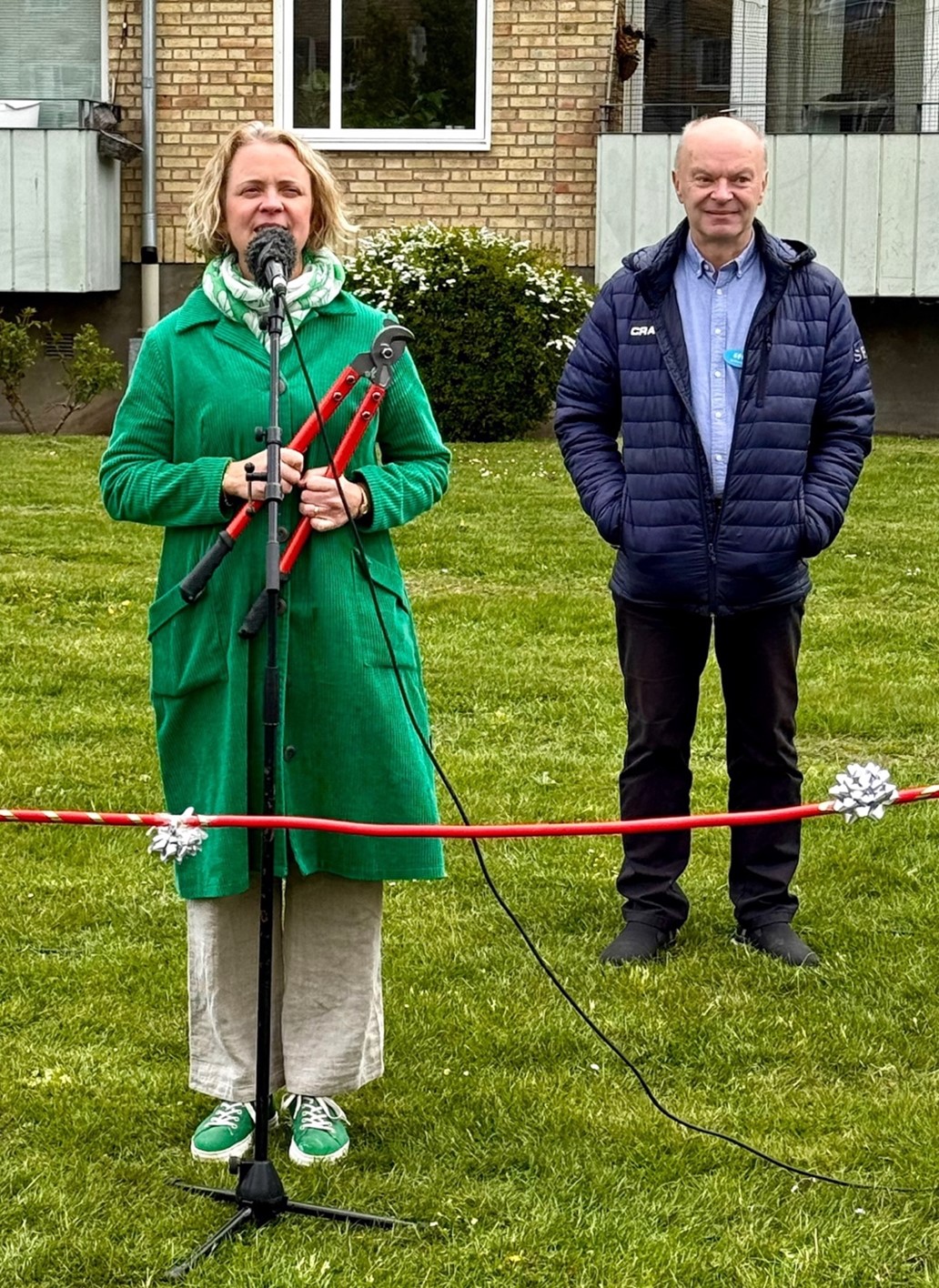
Inauguration with Kalmar municipality’s sustainability strategist Elvira Laneborg.
Still much left to do
When Bo is asked if the Safiren project is finished, he laughs and shakes his head:
“No, there is still a lot to do. We’re going to fine-tune and optimize the technology, while making it easier for our tenants to use their energy even smarter. For example, we plan to set up digital screens in the stairwells and by the electric car chargers outside the buildings, which can be used by both residents and visitors. The screens will be linked to the weather forecasts, which drive electricity price forecasts. Through ‘nudging’, we want to make our tenants live and act more sustainably.”
Two additional properties in Kalmar are expected to adopt solutions similar to Safiren. Furthermore, another two SBF properties – one in Helsingborg and one in Luleå – are set to be evaluated.
It is crucial that property owners across all seven of Sweden’s climate zones demonstrate that projects like this can be successfully implemented. While the solutions may differ depending on factors such as climate and local conditions for solar and geothermal energy, the potential for success remains consistent.
Investment case with many winners
Not only Bo Wernersson is proud of the Safiren project, but the whole company. SBF CEO Terje Björsell believes the project will inspire many property owners to convert their properties, since it has so many positive effects:
“The microgrid project in Safiren has meant an investment of around SEK 10 million. It’s a lot of money, but we have estimated the annual return from lower costs and higher revenues at around SEK 950,000 per year, which increases the property value by around SEK 9 million. Both our investors and our tenants are winners, while we are also reducing the pressure on the electricity grid and the climate. A win-win-win-win if you will.”

Terje Björsell, CEO of SBF Fonder
Would you like to know more? Please contact us:
Bo Wernersson, Head of Property Management
Anette Harby, Head of Communications and Sustainability
The Safiren project in brief:
- The property consists of 5 buildings with a total of 97 apartments and 3 protective shelters
- Built in 1964
- Previous energy efficiency measures:
- New heat pumps and heat exchangers
- New windows and balcony doors
- Additional insulation of the attics
- AI-based control system Egain
- The microgrid project:
- 5 smaller power feeds became 1 large of 600 A, reducing the connection fee and enabling larger solar electricity sales
- Internal grid distributes production and consumption between the buildings
- 727 solar panels with 320 kW peak power and 355 MWh per year of estimated production
- Existing storage tanks totalling 8,000 litres of water are used for energy storage
- 16 electric car chargers for residents and visitors with up to 22 kW power
- Individual metering and billing, and a framework agreement on green electricity in all homes
- Investment of around SEK 10 million, estimated to yield an annual return of SEK 950 thousand and increase the property’s value by SEK 9 million